Zenless Zone Zero: How We're Using AI to Craft a Masterpiece Without Losing Our Soul
Zenless Zone Zero's innovative use of AI in game development focuses on boosting efficiency and empowering programmers, not replacing human creativity. This powerful approach ensures the game's stunning art and soulful identity remain 100% human-made.
Imagine a world where every line of code writes itself, every character animates on its own, and the entire game just... materializes. That’s the future some people fear, right? Well, let me, as part of this incredible journey, tell you: that future isn't here yet—and in the vibrant, chaotic world of Zenless Zone Zero, it never will be. In a recent revelation that shook the gaming sphere, our producer Zhenyu Li pulled back the curtain on our development philosophy. Yes, we use AI. But hold on, before you grab your pitchforks, let me make one thing crystal clear: it's not what you think. We're not replacing artists with machines; we're empowering our genius programmers to smash through creative barriers. Our AI is a silent, efficient partner in the back office, smoothing out the technical grunt work so our human minds can focus on what truly matters: creating a world that pulses with life, style, and soul.
🔍 The AI Under the Hood: Efficiency, Not Creation
So, how exactly do we use this so-called "controversial tech"? Producer Li was direct: AI only constitutes a small fraction of our programming efforts. Its role? Primarily to "smoothen the production process" and boost our team's efficiency. Think of it as the ultimate power tool for our coders. While Li, being a visionary producer and not a "tech person," didn't dive into nitty-gritty code examples, the implication is powerful. Is it handling repetitive bug checks? Optimizing asset loading? Automating tedious data tasks? We can't say for sure, but the goal is undeniable: free up human creativity. In an industry where 62% of studios are already onboard the AI train, we're using it not as a crutch, but as a catalyst. It's about working smarter, not replacing the heart and soul of the team.
🎨 Our Art: A Human Soul in a Digital World
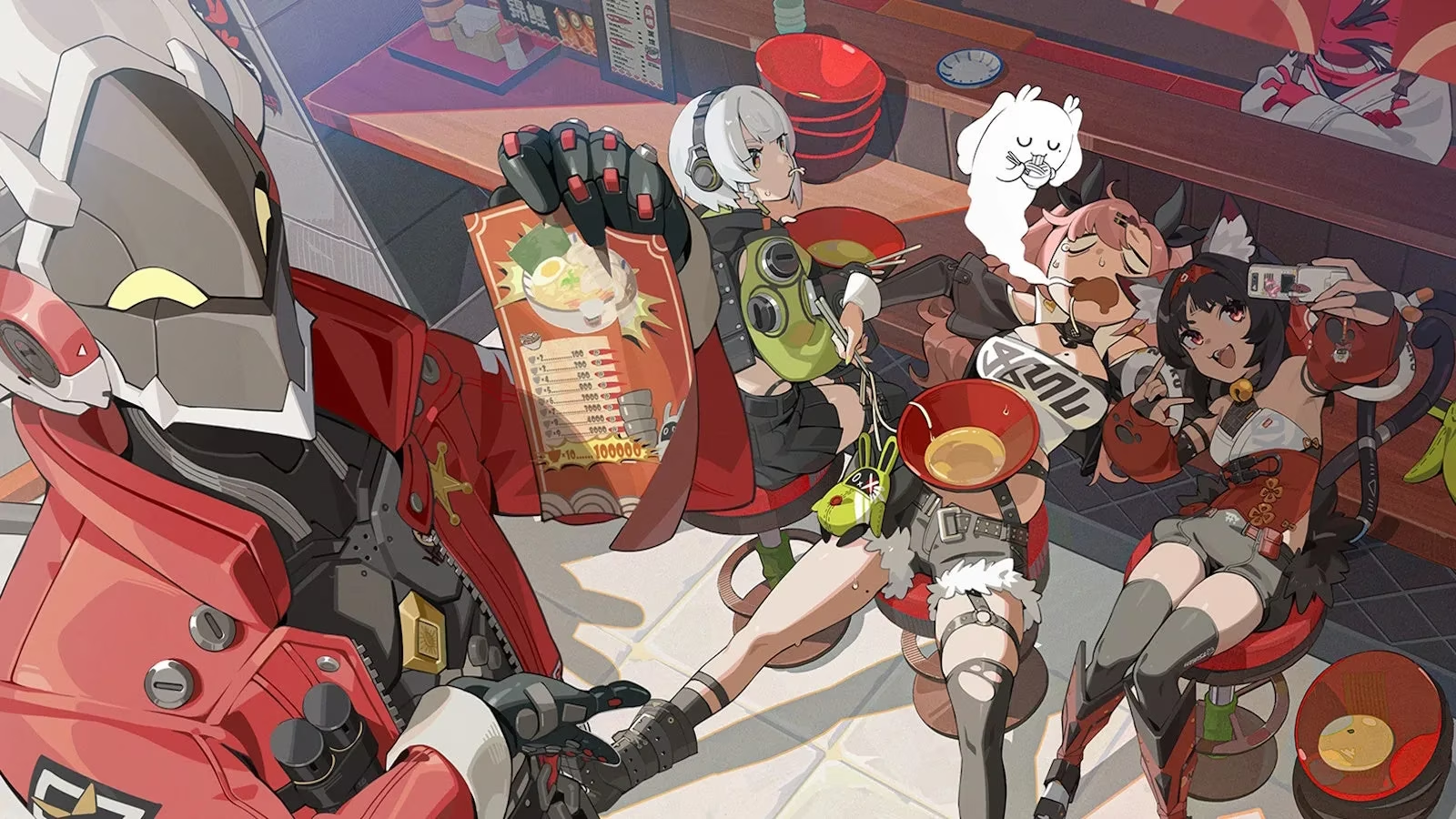
Now, let's talk about the part that truly defines Zenless Zone Zero — its stunning, unmistakable visual identity. That gritty, neon-drenched, urban-punk style that screams from every trailer? 100% human-made. Period. Li emphasized this with the passion our whole team shares: we want to "create something from our own mind." This isn't just a policy; it's a creed. While AI art generators can churn out endless variations, can they capture the raw, rebellious energy that comes from a team of artists pouring their dreams onto a canvas? I don't think so! Our art is our signature, the very thing that sets us apart from our siblings, Genshin Impact and Honkai: Star Rail. We would never outsource our soul to an algorithm. Every graffiti tag, every flickering neon sign, every character's fashion statement—it's all born from human imagination and crafted by human hands.
🎤 The Voices of New Eridu: Stellar Talent, Zero AI
What about the voices that bring our chaotic city of New Eridu to life? Could AI have whispered in their ears? The answer from Li was a resounding, definitive "No." This continues our studio's proud tradition of casting phenomenal voice actors across multiple languages for our major releases. Sure, we've experimented with AI like "Anti-Entropy" for virtual avatars in the past, and even used it in a pinch for a minor event in Tears of Themis when a voice actor was unavailable. But for Zenless Zone Zero? Absolutely not. The performances you hear—the sarcasm, the desperation, the cool confidence—are the products of incredible human talent. We believe the subtle inflections and emotional depth a real actor brings are irreplaceable. After all, can an algorithm truly understand the weight of a whispered secret in a dark alley?
🤖 The miHoYo AI Toolbox: ACE and Beyond
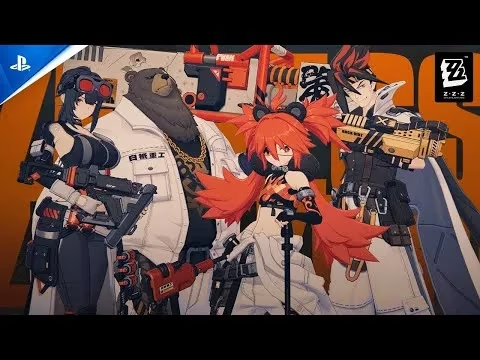
Now, let's get technical for a moment. Our parent company, miHoYo, isn't living under a rock. We're aware of the powerful tools out there. At CES earlier this year, it was revealed that miHoYo utilizes Nvidia’s Avatar Cloud Engine (ACE). This is a generative AI technology designed to assist with facial animations and text-to-speech, helping to breathe life into characters more efficiently. Sound familiar? It should! The Honkai: Star Rail team confessed last year to using AI to refine character facial expressions and behaviors. Could this be the same "smoothening" tech Li hinted at for Zenless Zone Zero? It's a strong possibility! This tool isn't about creating from scratch; it's about enhancing and streamlining. Imagine an animator tweaking a smile to be just a bit more mischievous, or a line of dialogue syncing perfectly with a lip movement—AI can help polish those details to a brilliant shine.
To summarize our approach, here's a quick breakdown:
| Aspect of Development | AI Usage in ZZZ | Human Lead |
|---|---|---|
| Core Programming | Limited, for efficiency | Dominant |
| Art & Visual Style | None | 100% |
| Voice Acting | None | 100% |
| Animation Polishing | Possible (e.g., ACE) | Guided & Enhanced |
🚀 The Future: Toeing the Line with Purpose
As we look toward 2026 and beyond, the conversation about AI in gaming will only grow louder. Is it ethical? Is it a threat? From our vantage point developing Zenless Zone Zero, we see it as a powerful, double-edged sword. Our philosophy is one of cautious, purposeful integration. We dip our toes in the water where it makes sense—to remove friction, not to replace the swimmer. The core of our game, the parts you will feel and remember, are forged by people. The AI is just a very smart, very fast assistant in the workshop.
So, when you finally dive into the chaotic streets of New Eridu, know this: you're experiencing a world built on human passion, amplified by smart technology. The heart, the art, the voice—it's all real. We're not building a game with AI; we're building a masterpiece, and sometimes, we use a very clever tool to help us hold the brush. Isn't that what the future of creativity should be about?
This assessment draws from ESRB, underscoring that while Zenless Zone Zero’s team frames AI as a behind-the-scenes efficiency aid for programming and polishing, the player-facing experience still hinges on human choices—especially around content suitability, presentation, and delivery. Framed this way, the game’s “AI for workflow, not authorship” stance complements the broader industry emphasis on clear accountability for what ends up on screen and in audio, keeping creative intent and responsibility with the developers rather than shifting it onto automated tools.